
What is Obon?
Obon is a Japanese Buddhist memorial for the dead. In Japan, Obon observers return to their hometowns, visit and clean their family graves, make offerings, conduct religious services, and participate in Bon dances (Bon odori or Obon odori), often held in parks, plazas, public spaces, or temple and shrine grounds. Ancestral spirits are said to visit the physical world during Obon, guided by candles, lanterns, floating lanterns, or bonfires. For some participants, this visitation is interpreted metaphorically as the remembrance of those who have died.
What are the origins of the Obon tradition?
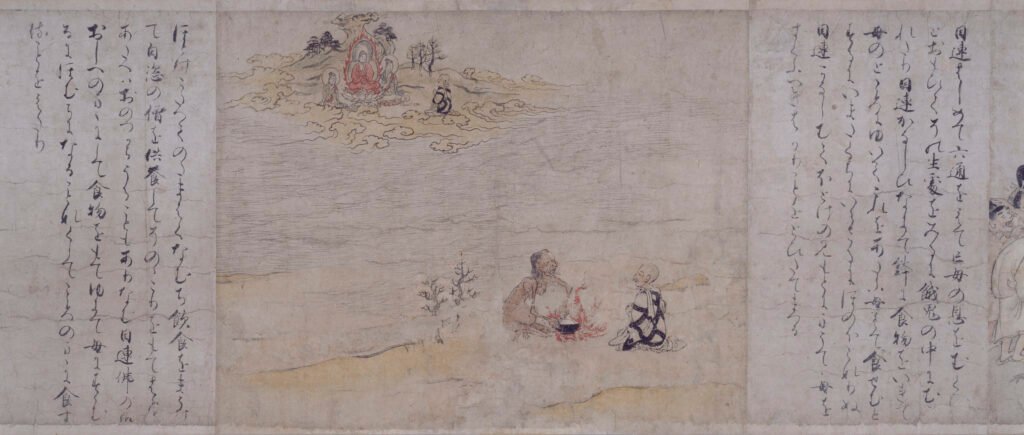
“Bon” and “Obon” (with the honorific “O-”) are abbreviated forms of “Urabon,” the Japanese transliteration of the Ullambana Sutra. In this text, the Buddha explained to his disciple Maudgalyayana that his mother’s karma was so evil she could only be helped through the intervention of all the monks in the ten directions, that is, in all realms and dimensions. The Buddha instructed Maudgalyayana:
On the fifteenth day of the seventh month, when the monks end the summer retreat, for the sake of your parents of the past seven generations and your present suffering parents, you should fill a tray with the world’s finest delicacies, together with foods of rich variety and taste and five kinds of greens and cereals, and offer it to the monks in the ten directions. You should also offer them ladles, kettles, basins, perfumed oils, lamps, carpets, and bedding.
Following the Buddha’s instructions, Maudgalyayana (Mokuren, in Japanese) made offerings to the monks, received their prayers on behalf of his family, and attained salvation not only for his mother but for seven generations of ancestors.
When is Obon celebrated?
Obon in Japan was traditionally celebrated on the fifteenth day of the seventh moon in the lunisolar calendar, aligning Obon with the full moon. After the Japanese adoption of the western Gregorian calendar in 1873, Obon was observed on and around July 15, August 15, or on the fifteenth day of the seventh moon in the lunisolar calendar. The July date is a literal rendering of the Ullambana text to the Gregorian calendar, while the August date is typically closer in time and season to the original observation. Some regions, like the Okinawan and Amami Islands, continue to follow the lunisolar calendar.
In the United States, the tradition of Obon was adapted to occur on the weekends, ideally those closest to July 15 or August 15. However, in areas with numerous Japanese Buddhist temples, Bon dances occur throughout the summer. In Southern California, the Bon dance season lasts from June through August, and on Oahu Island, the season stretches from June through early October.
What are the origins of Bon dance?
Bon dance may have developed from Buddhist chanting and ritual dance (odori nembutsu) associated with the monks Kuya Shonin in the 10th century and Ippen Shonin in the 13th century. This practice was gradually incorporated into Obon observances and produced a wide range of local and regional dances. Bon dance flourished until the early years of the Meiji period, when the new government suppressed Buddhism in favor of Shinto (shinbutsu bunri). By the mid-1870s, these edicts were no longer strictly enforced and the traditions of Obon and Bon dance gradually resumed in Japan.
Are Bon dances secular or religious?
For some people in Japan and the Japanese diaspora, Obon and Bon dancing are cultural traditions, religious in origin but observed more like a national holiday with elements of Shintoism, Buddhism, and regional folk traditions. For others, Obon remains a Buddhist holiday and Bon dancing is part of the Japanese Buddhist observance of Obon. In this way, the observance of Obon and Bon dancing include elements of secular and religious traditions at the same time.
When did Bon dance start in Hawai‘i?
In the 1880s, Japanese laborers began to migrate in considerable numbers to the Kingdom of Hawai‘i and the United States of America. The earliest recorded Obon with Bon dance in Hawai‘i took place in 1885 on a sugar plantation north of Hilo in Wainaku on the Hawai‘i Island. In time, informal groups of singers, flutists, taiko drummers, and percussionists played for Bon dances throughout Hawai‘i, especially among emigrants from Fukushima, Hiroshima, Niigata, Yamaguchi, and later, Okinawa.
When did Bon dance start in the continental United States?
In the continental United States, Bon dance first occurred in the 1920s at prefectural association (kenjinkai) gatherings and Koyasan Buddhist Temple’s Obon in Los Angeles from 1922 through the 1930s. However, most temples celebrated Obon with religious services, guest speakers, and a cemetery visit, possibly including entertainment such as theater performances or Japanese movies. Bon dance became a regular part of Obon observances in the 1930s through the work of Reverend Yoshio Iwanaga.
What happened to this tradition during World War II?
After the bombing of Pearl Harbor and the passing of Executive Order 9066 in February 1942, people of Japanese descent living on the American West Coast were incarcerated by the U.S. government in temporary detention centers hastily built on fairgrounds, racetracks, former labor camps, and livestock facilities. Despite the harrowing conditions, Obon with Bon dance was celebrated that summer in Merced, Pinedale, Pomona, Stockton, Tanforan, and Tulare. Bon dance was included in Puyallup’s Independence Day program and was the final number in Portland’s mid-July Talent Revue.
From May to November 1942, the incarcerated population was moved further inland to more permanent concentration camps administered by the War Relocation Authority (WRA). Over the next three years, Obon was celebrated in all ten of the WRA camps with Buddhist services, Bon dance, music, lighting, decorations, and refreshments. Some communities even printed Obon posters and programs, organized a bazaar, built a yagura, or obtained or made a taiko.
When did Obon and Bon dance resume after World War II?
After the war, Bon dance was likely considered too public and showy, and therefore, too risky an endeavor for new and returning communities. In 1948, however, the national organization Buddhist Churches of America celebrated its 50th anniversary with nine days of programming, concluding with a Bon dance on the plaza of the San Francisco Civic Center.
Bon dance gradually returned to the West Coast and Mountain states and was danced for the first time in locations such as Chicago, Cleveland, Minneapolis, New York City, Washington D.C., and rural Seabrook, New Jersey. To this day, Bon dance remains a vibrant religious and cultural practice and is commonly danced at Japanese Buddhist temples, community centers, schools, festivals, and pilgrimages to former concentration camp sites.
Where can I find Obon and Bon dance events?
There are Obon and Bon dance events throughout the Hawaiian Islands and the continental United States. Obon calendars can be found on the websites of the Buddhist Churches of America, Japanese-City, and the Japanese Cultural Center of Hawaii.
Tips for first-time attendees.
Parking information for Obon and Bon dance events can often be found on the temple or venue’s website. Festival food is usually offered for sale, either from the temple community, caterers, or food trucks. While many temples accept credit cards, cash in small denominations is appreciated.
Some people will wear festival attire like happi coats or summer kimono (yukata), but many attendees simply wear street clothes.
In Hawai’i, public Obon events are generally referred to as “Bon Dances” and occur on Fridays and Saturdays. Participants will often bring their own folding chairs to ensure a place to sit. In the continental United States, Obon events are generally referred to as “Obon Festivals” and occur on Saturdays and Sundays.