
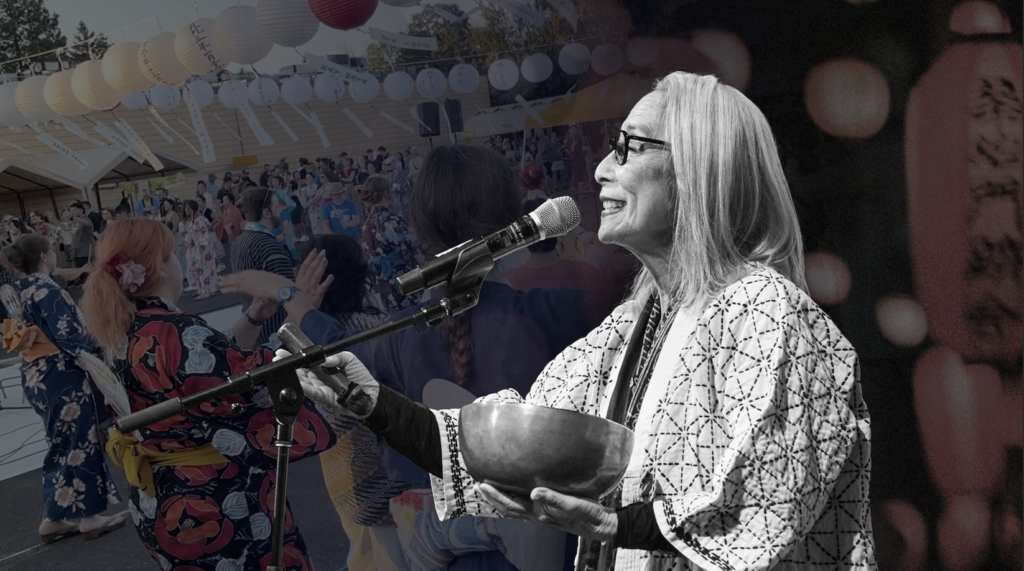
In the summer of 2020, with the COVID-19 pandemic forcing people into isolation, artist and activist Nobuko Miyamoto wrote from her home in Los Angeles, California:
i miss
yagura and lanterns
crowds in happi coats and tennis shoes
i miss smiling whole faces
the hint of incense wafting from the temple
i miss little girls wearing the wonder of their first kimono
elders chatting and fanning themselves with uchiwa
i miss obon

i miss
dressing room chatter
bare feet on tatami
i miss the firm hands of ladies wrapping us in yukata
wearable origami in bold patterns
re-minding us of who we still are
i miss obon

i miss
dancing through the gate to the music of Bon Odori Uta
trying to be graceful, geta on concrete
i miss being in a moving village forming circles around circles
dancing the steps of our ancestors
losing ourselves to remember them
i miss obon

i miss
the don of taiko, the twang of shamisen
climbing the yagura
Atomic Nancy's voice reaching for the moon
i miss my breath pressing against obi
singing shoulder to shoulder to a sky turning indigo
i miss the village dancing round us
a constellation of joy
a moment of oneness
i miss i miss i miss ... i miss obon1
Two years later, many of these thoughts and sentiments would reappear in a new Obon song called “Kangie” (“Gathering of Joy”), commissioned by the Buddhist Churches of America’s (BCA) Music Committee and Bon Odori–Taiko Subcommittee.
Miyamoto’s “Kangie” evokes the soundscape of gagaku, the traditional court music of Japan. As she later explained in an interview, “I wanted to expand our ears and our bodies to take in some ancient sounds that we don’t usually hear in Obon. To reintroduce ourselves into the circle and just dance again. But to dance held together by something greater.”2
The song slowly unfolds with the sounds of the taiko (drum), sho (free-reed mouth organ), tsuzumi (hourglass drum), bamboo flute, and vocal exclamations. The taiko, atarigane (metal bell), and shamisen (three-stringed instrument) maintain a steady groove while the other instruments float ethereally around a drawn-out and deliberate vocal melody. This meditative section is contrasted with a more upbeat verse with lyrics that echo Miyamoto’s pandemic-era poem.
Miyamoto describes the structure in this way: “There are two sections, two feelings in this piece. One is that calling feeling, that ancient calling feeling. And then there’s the other one that is sort of the joy, like what I feel when I go and get dressed, that the ladies come and dress you.”
The song references “Bon Odori Uta,” a traditional Bon dance that is often used as the first and/or last dance at BCA temples, and “1 + 1” or “Ichi Tasu Ichi No Ondo,” an extremely popular dance among youths in Southern California. In the end, the chanting of “Issei – nisei – sansei – yonsei, nisei – sansei – yonsei – gosei” cycles numerically through the generations while overlapping with the original chorus and the new refrain, “A village – moving as one.”
Wear your happi or yukata
Don't forget your tenugui
Wear your sneakers or your geta
Can you tie my obi?

Little girls in first kimono
Holding hands with baachan
Teenage boys in hachimaki
Waiting for 1+1

Come.....into the circle
Come.....into the gathering of joy yoi!
Come.....into the circle
Kangie! ..... Yuiyo!

Obon - coming hom
Obon - we remember the dead
Obon - dancing in their footsteps
Joyfully ..... Kangie!

From the yagura hear the taiko
Paper lanterns fill the sky
Time to gather in a circle
See the moon is rising

Scent of incense from the temple
Hands together - gassho
Time for Bon Odori Uta
Ikimasho!3
The work was inspired by conversations with Reverend Masao Kodani, Minister Emeritus of the Senshin Buddhist Temple in Los Angeles. The dance was choreographed by Miyamoto, Elaine Fukumoto, and Rev. Kodani, and included allusions to the Japanese court dance of bugaku as well as the more literal movements of tying an obi and hachimaki.
An extraordinary roster of musicians contributed tracks to the recording including Miyamoto, “Atomic” Nancy Sekizawa, and Helen Ota (vocals), Mark Izu (sho), Mike Penny (shamisen), Kaoru Watanabe (flute), Isaku Kageyama (taiko), and Kenny Endo (tsuzumi and percussion). Miyamoto wrote the lyrics and co-composed the music with producer and recording engineer Derek Nakamoto.

In 2026, Nakamoto released the documentary The Making of Kangie with interviews and video footage from the studio recording sessions. The film debuted at the Silicon Valley Asian Pacific Film Festival and will be available for streaming sometime in the future. The audio recording is currently downloadable and is accompanied by a dance instruction video and interview on the BCA’s Obon: Gathering of Joy webpage.
Nobuko Miyamoto is a Los Angeles-based artist who starred in Broadway theater productions and classic Hollywood films before devoting herself to Asian American activism and artistic practice. She toured and recorded A Grain of Sand with Chris Iijima and William “Charlie” Chin, sang in the fusion band Warriors of the Rainbow, and established her own performing arts organization Great Leap. She wrote the first English-language Bon odori song, “Yuiyo,” in 1984, and since then, has written eight more Bon odori: “Tampopo Ondo” (1994, rev. 1998), “Gardener’s Song – Gadena Bushi” (1998), “Ichigo Ichie” (2003), “Mottainai” (2011), “Bambutsu no Tsunagari” (2013), “Senbazuru” (2016), “Kangie” (2022), and “120,000 Stories” (2026).
Her memoir Not Yo’ Butterfly: My Long Song of Relocation, Race, Love, and Revolution was published by the University of California Press (2021), and she was the subject of the award-winning documentary Nobuko Miyamoto: A Song in Movement (2024). For more information, see Nobuko Miyamoto’s personal website and her performing arts organization Great Leap.
- Nobuko Miyamoto’s poem, “I miss Obon…” can be found on her website. ↩︎
- Quotation extracted from a transcription of an interview with Nobuko Miyamoto and Reverend Masao Kodani by Wynn Kiyama, November 18, 2024. Portions of this interview are featured in the documentary The Making of Kangie, 2026.] ↩︎
- Excerpt from Nobuko Miyamoto’s lyric sheet to “Kangie.” ↩︎