
At most Obon festivals, participants are welcomed with the sight of hanging lanterns, the smell of festival food, and the sound of scratchy old records preserved in digital copies. But at a number of Obon festivals in Northern California, from San Jose and Palo Alto to Oakland and Union City, a live big band is an unexpected addition to the festival soundscape.
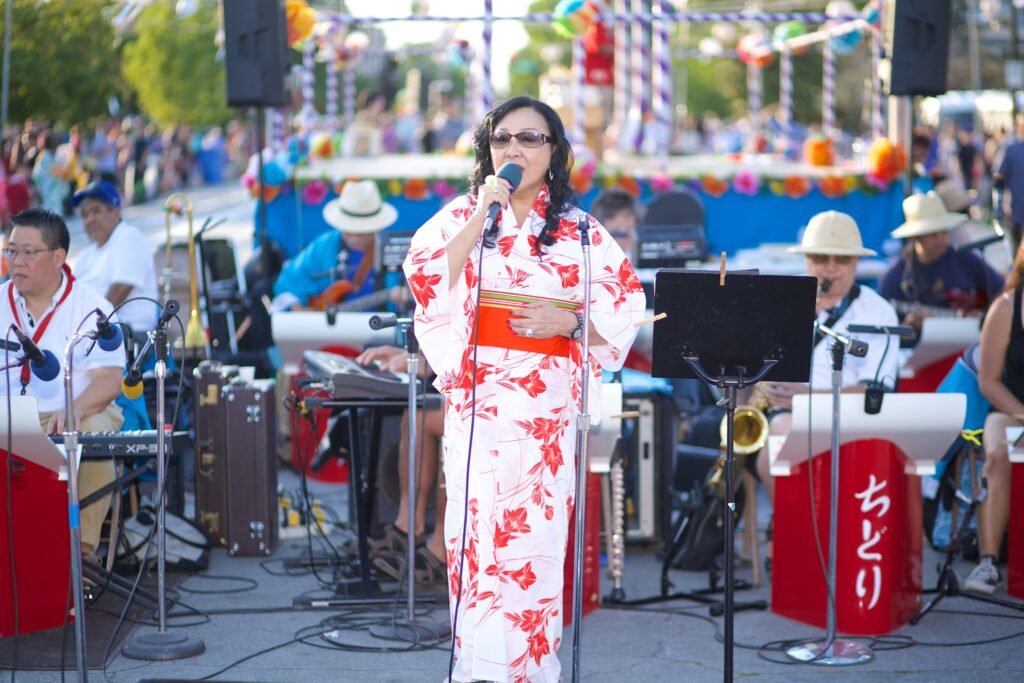
The San Jose Chidori Band was formed in 1953 to entertain the Issei community of San Jose with performances of nostalgic Japanese songs. Young musicians, especially those who had played in the mandolin or jazz bands in the American concentration camps, were recruited to join the band. As founding member Masayo Arii described it in a 2009 interview, “The band played in unison, nothing fancy, we just everybody played the same thing.”
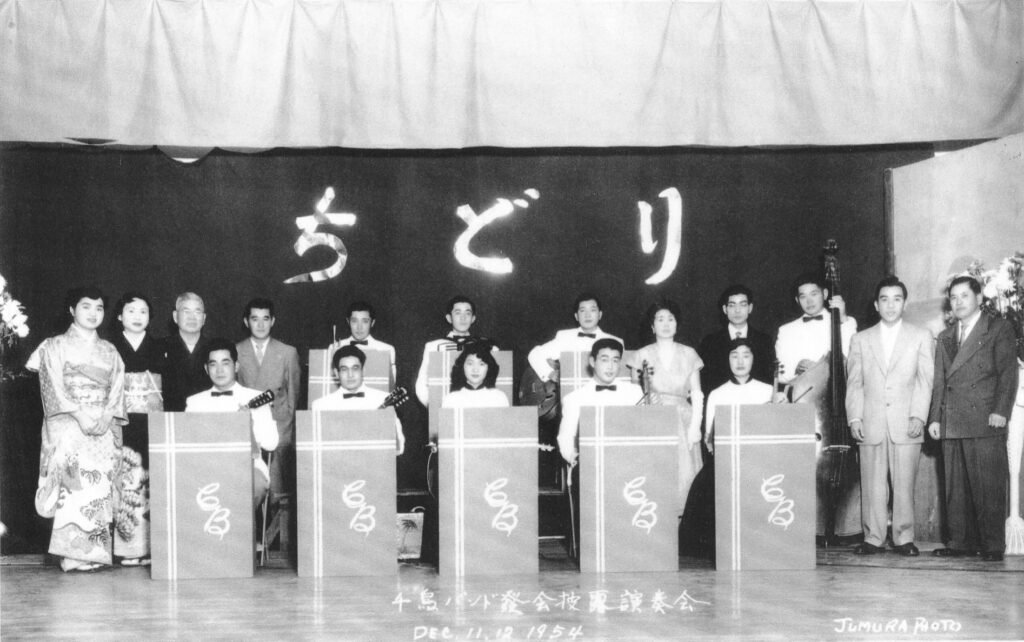
In the early years, the band was made up of vocalists and instrumentalists playing the violin, clarinet, mandolin, accordion, guitar, upright bass, and drum set. In time, many of these instruments were replaced by trumpets, trombones, saxophones, keyboards, and the electric bass. The band played at local events, self-produced an annual concert at Okida Hall in San Jose’s Japantown, and started performing at the San Jose Buddhist Church Betsuin’s Obon in 1959. Since then, the band has performed at Obon festivals in Alameda, Mill Valley, Mountain View, Oakland, San Francisco, San Jose, and Union City.
In addition to its repertoire of Japanese popular music spanning the postwar years to modern times, the band has a huge catalog of Bon odori music including religious, traditional, modern, and original compositions. One of the band’s signature songs, “Chidori Band Ondo,” was written by singer Reiko So, arranged by bandleader Duane Takahashi, and choreographed by Reiko Iwanaga (Reimichi Hanayagi). It was first performed as a Bon odori in 2009, commemorating the band’s fifty years of participation in the San Jose Obon Festival. Since the 2010s, the San Jose Chidori Band has collaborated with San Jose Taiko for live performances of “Shiawase Samba,” “Hinokuni Daiko,” and “Imperial Request.”
During the COVID-19 pandemic, many Buddhist temples shifted their programs online to YouTube and were suddenly confronted with copyright violations for their use of Bon odori music. The Chidori Band generously offered their recorded tracks for online Bon odori to Buddhist Churches of America’s temples, free of charge.
The San Jose Chidori Band still produces an annual concert, now held at the San Jose Buddhist Church Betsuin, which highlights the group in a semiformal setting. But for many performers, the Obon appearances are equally if not more rewarding. Ron Montano, a dynamic singer of Spanish and Japanese heritage, grew up speaking Japanese with his maternal grandmother and began singing with the Chidori Band in 2004. He remarked, “The thing I like most about performing at all the Obons is seeing family and friends that come back to town. Almost my whole family has moved out of San Jose, so it’s always nice to see them come back for San Jose Obon.”
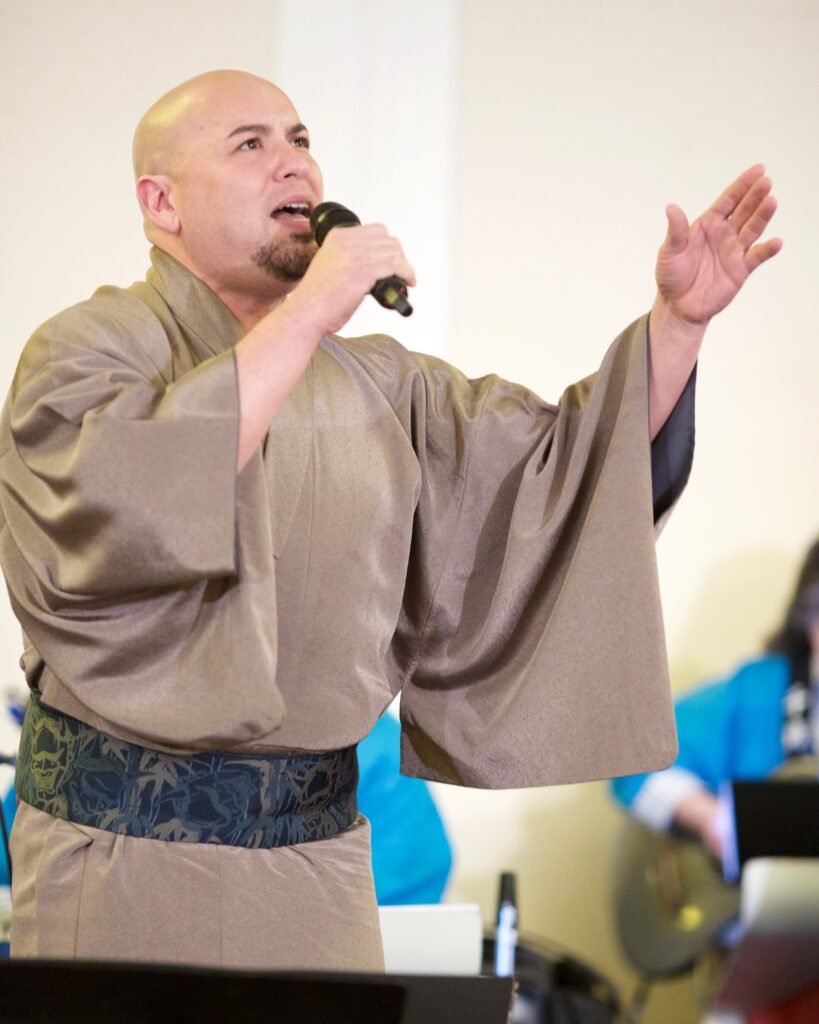
The band has featured numerous vocalists through the years including Shizuko Adachi, Masayo Arii, Nic Chen, Hideo Cohen, Toni Dobashi, Kozue Hiruma, Seiji and Yoko Inada, Toshiharu Kasamura, Mariko Kiyono, Tsukasa Kobashi, Keiko Manning, Doris Mitchell, Ron Montano, Mikako Palmer, Eiko Ragsdale, Tom Sakai, Marc Sanwo, Reiko and Kenichi So, Yuri Takahashi, Kay Tani, Shigeru Tashiro, Ted Uchida, Yuki Watanabe, Michael Yoshihara, and Corinne Young.
Instrumentalists have included Wayne Adachi, Rod Arii, Ichiro Bakoshi, Steve Doi, Leonard Fujita, Gene Hirano, Carolyn Iida, Darin Ishimatsu, Nate Kakutani, Emily Kawaguchi, Allison Kobayashi, Neha Kulkarni, Mack Kusumoto, Chris Nalls, Fleurette Sevin, Grant Shimizu, Tom Taba, Larry Takagi, Duane Takahashi, Melina Takahashi, Nathan Takemori, Kirk Tamura, Ken Tanaka, Kathy Tippetts, Ken Weir, Shirley Muramoto Wong, Rie Yamada, and Michael and Miwa Yoshihara. The group has recorded three CDs: The San Jose Chidori Band (2006), Portfolio of Passion (2008), and Obon—Chidori Style (2012). For more information, visit their website here.